
How the Invoice Module Works
The Invoice Module takes your vendor invoices from submission to approved cost data, automatically. No manual data entry. No spreadsheets. Just clean, matched, auditable invoice records.
| Step | What Galley does |
|---|---|
| 1. Submit | Upload files, forward by email, enter manually, or receive via EDI |
| 2. Scan | AI reads the invoice: vendor, items, quantities, prices, and totals |
| 3. Match | Each line item is matched to your vendor catalog automatically |
| 4. Review | Check results, correct anything off, and map any unmatched items |
| 5. Approve | Locks the invoice and updates your food costs and receiving records |
How to Submit Invoices
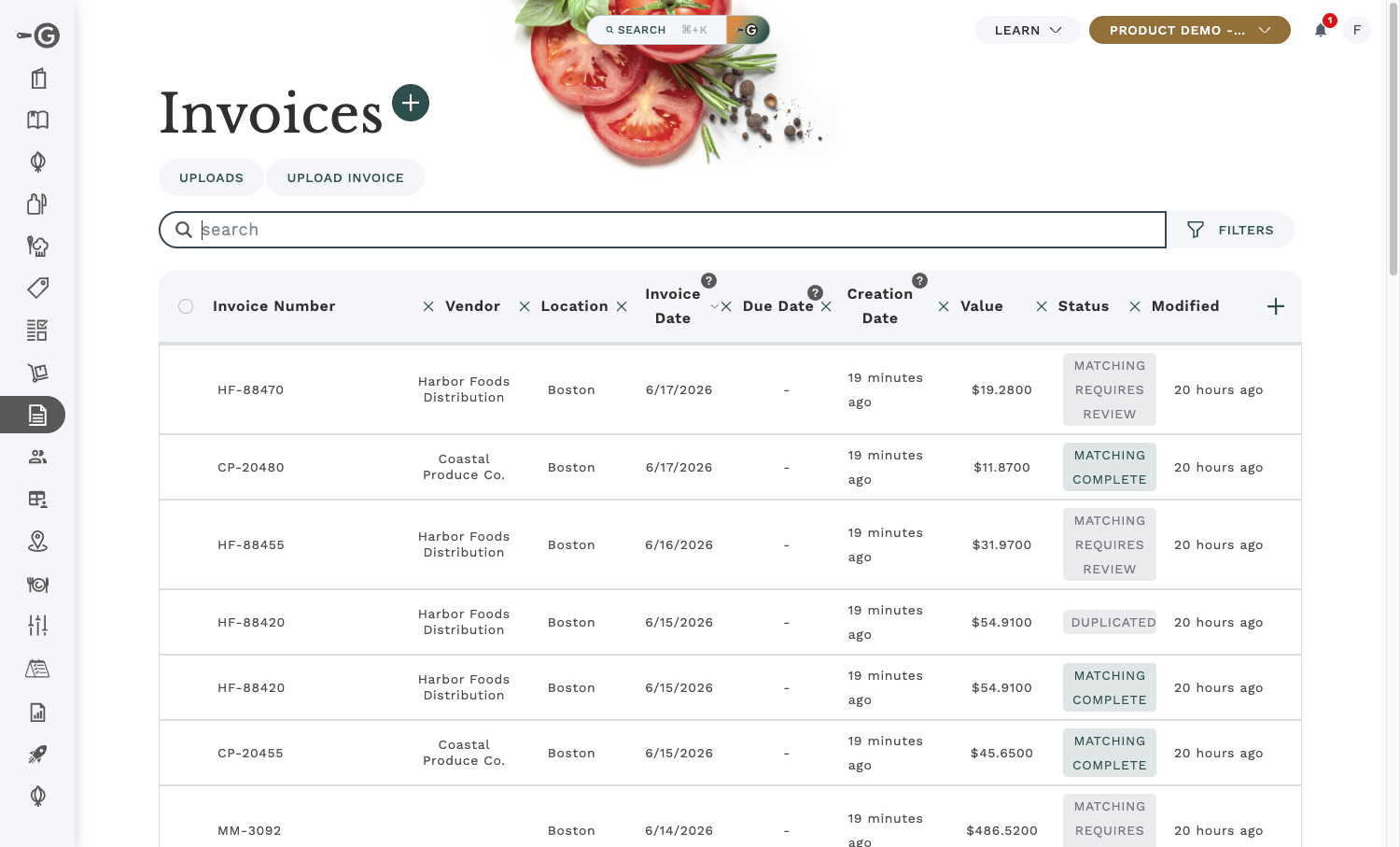
You have four ways to get invoices into Galley. Use whichever fits your workflow, or combine them.
| Method | Best for | Setup required |
|---|---|---|
| File upload | One-off uploads, scanned documents, batches | None |
| Email forwarding | Vendors who send by email, or staff forwarding from their inbox | Location intake email addresses (set up by Galley) |
| Manual entry | Invoices that cannot be scanned, or quick corrections | None |
| EDI | High-volume vendors with automated invoice delivery | Vendor EDI setup via your account manager |
Uploading Files
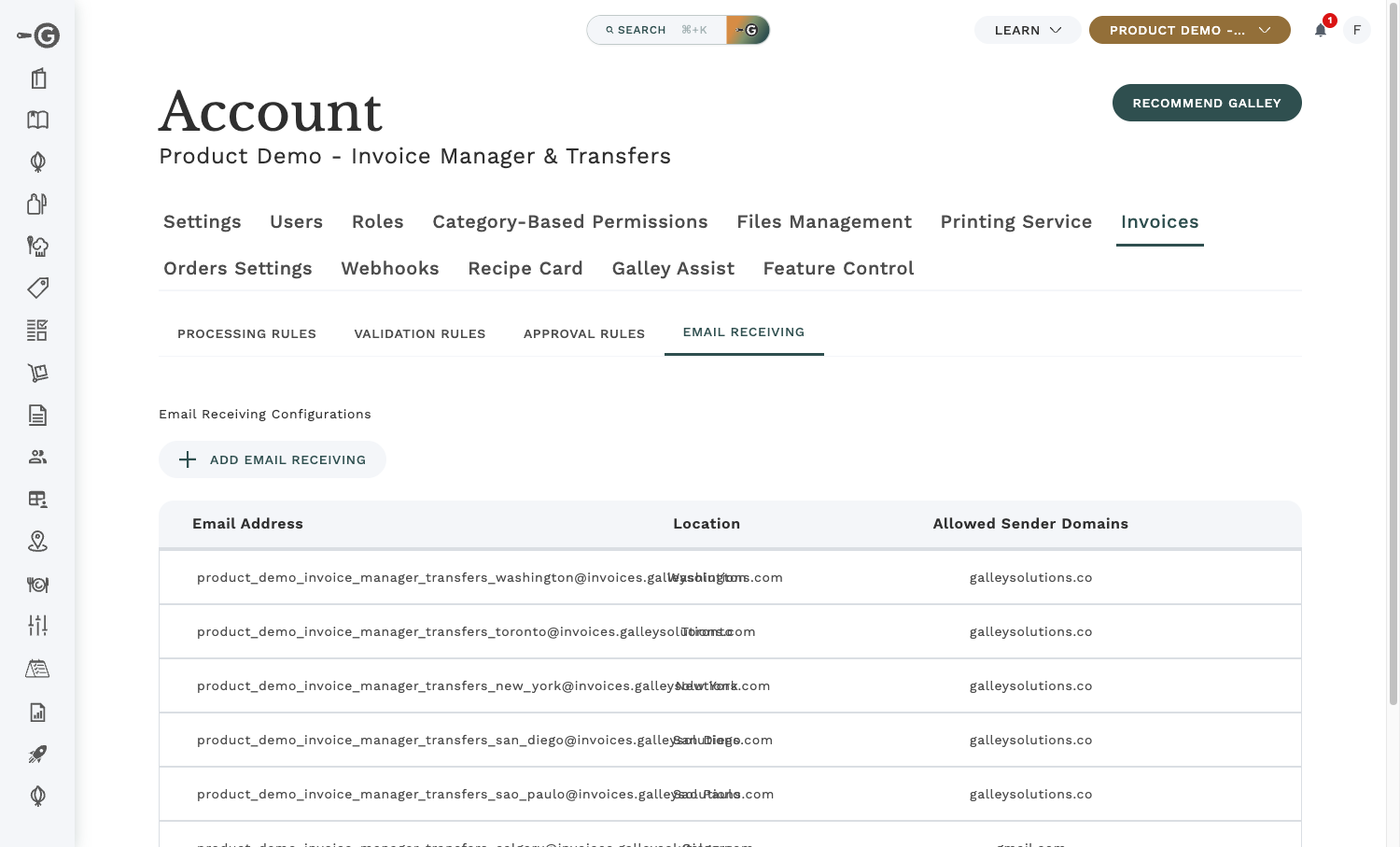
Go to the Invoices section and drag one or more files onto the upload area, or click to browse. You can upload multiple invoices at once. Galley processes them in a batch and tracks progress in the Upload Jobs page.
Galley accepts PDFs and common image formats. A single file can contain multiple invoices, and a single invoice can span multiple files. Galley sorts it out automatically.
Forwarding Invoices by Email
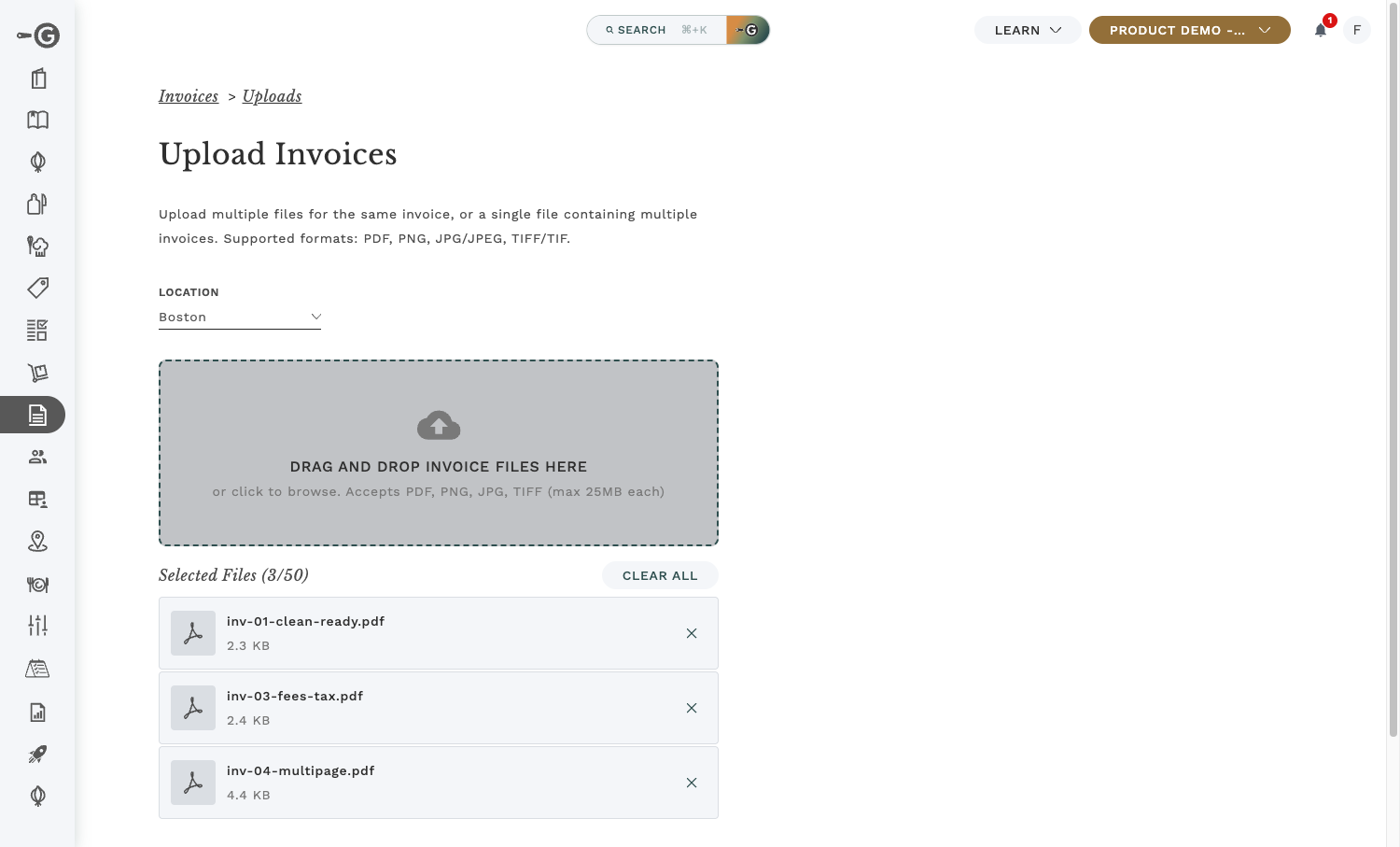
Each of your locations has a dedicated Galley intake email address. Forward invoices there, or ask vendors to send directly to that address. Galley extracts the attachments, scans them, and creates the invoices automatically. No downloading required.
Your location intake email addresses are set up by the Galley team. Contact your account manager or Galley support to get them activated for your locations.
A few things to know about email intake:
- One email address per location. Make sure vendors send to the right location's address.
- Multiple attachments in one email are fine. Galley processes all of them together.
- Only invoices, packing slips, and receipts are accepted. Other document types are flagged.
- Emails from unknown sender domains are rejected. Your administrator manages the allowed sender list under Settings, Invoice Rules, Email Receiving.
Entering an Invoice Manually
If you have an invoice that cannot be scanned, or need to make a quick manual entry, select "New Invoice" from the Invoices page. Fill in the vendor, location, date, and line items by hand.
Receiving Invoices via EDI
If your vendors support Electronic Data Interchange (EDI), invoices can arrive in Galley automatically with no action needed on your end. Contact your account manager to set up EDI connections with your vendors.
How Galley Reads and Matches Your Invoices
After you submit an invoice, Galley's AI works in two steps: reading the document and matching it to your catalog.
What the AI Reads
Galley extracts the following from every invoice:
| What Galley reads | Details |
|---|---|
| Vendor name | Matched to your vendor list automatically |
| Invoice details | Invoice number, date, PO reference, and totals |
| Line items | Item name, SKU, quantity, unit, and unit price |
| Document structure | Page splits for multi-page and multi-invoice files |
Matching to Your Catalog
Once data is extracted, Galley matches each line item to your vendor item catalog. Items it has seen before match automatically. New or ambiguous items are flagged for manual mapping.
Galley also checks for duplicate invoices based on vendor, location, and invoice number, so the same invoice does not get processed twice.
Galley gets smarter with every invoice. When you map a vendor item by hand, Galley remembers that decision and applies it automatically to future invoices from the same vendor. The more you use it, the less mapping you do.
Galley Learns From Your Corrections
The same is true for what the AI reads. When you correct an extracted field on a scanned invoice, Galley learns from that correction and uses it to read future invoices from the same vendor more accurately. Recurring quirks in a vendor's layout get handled for you over time, so the documents you fix today need less fixing tomorrow.
When Something Looks Wrong
If the AI misidentifies the vendor, picks the wrong location, or reads the wrong invoice number, you can correct it directly. No need to re-upload:
- Change Vendor: re-matches every line item against the correct vendor's catalog.
- Change Location: moves the invoice to the right location.
- Change Invoice Number: corrects the invoice number (available before approval).
If an invoice fails matching or comes back needing review, you can also Reprocess it to re-run Galley's matching from scratch. Reprocess is available from the invoice list as a bulk action: select the invoices that need it and reprocess them together.
The Invoice Review View
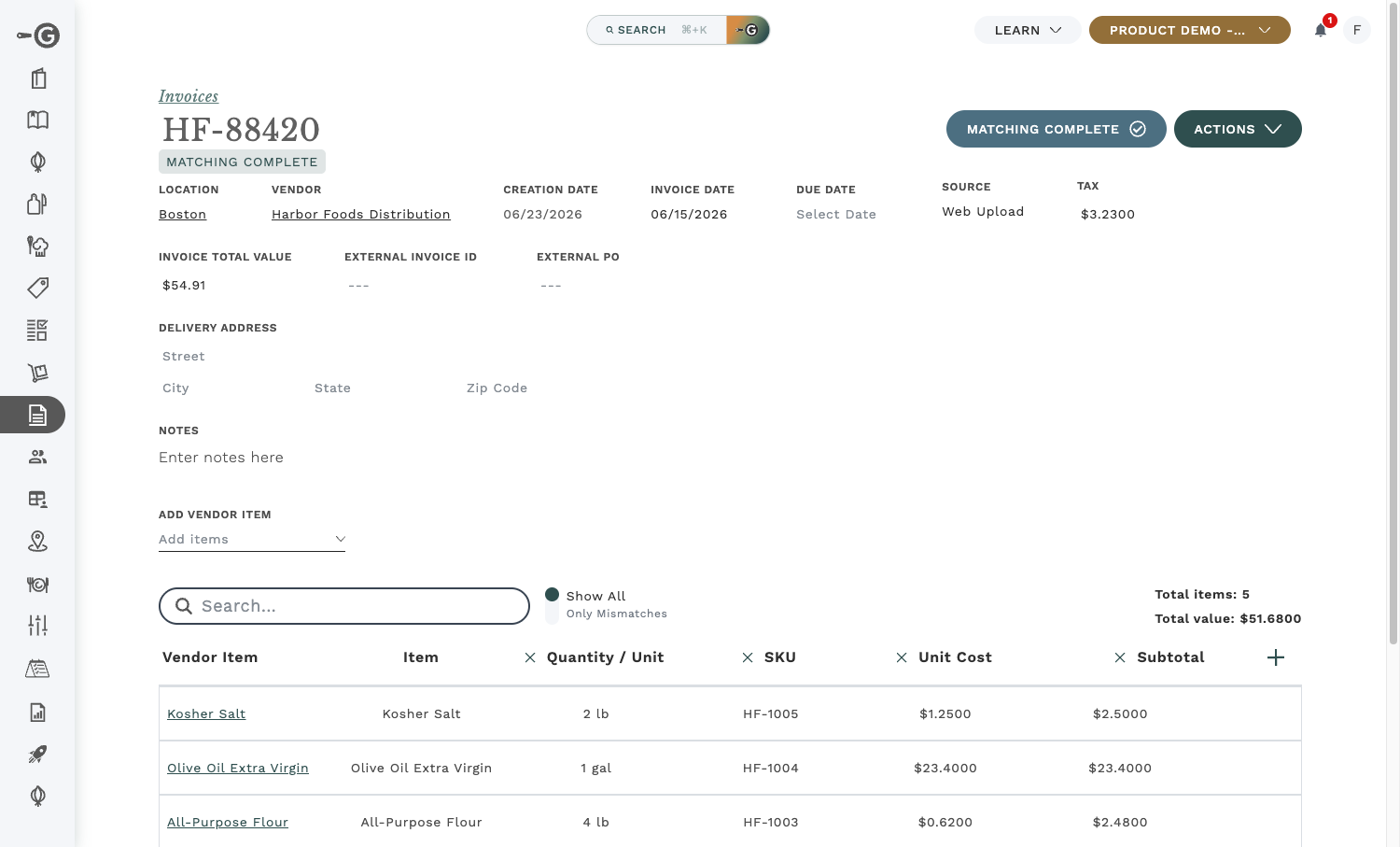
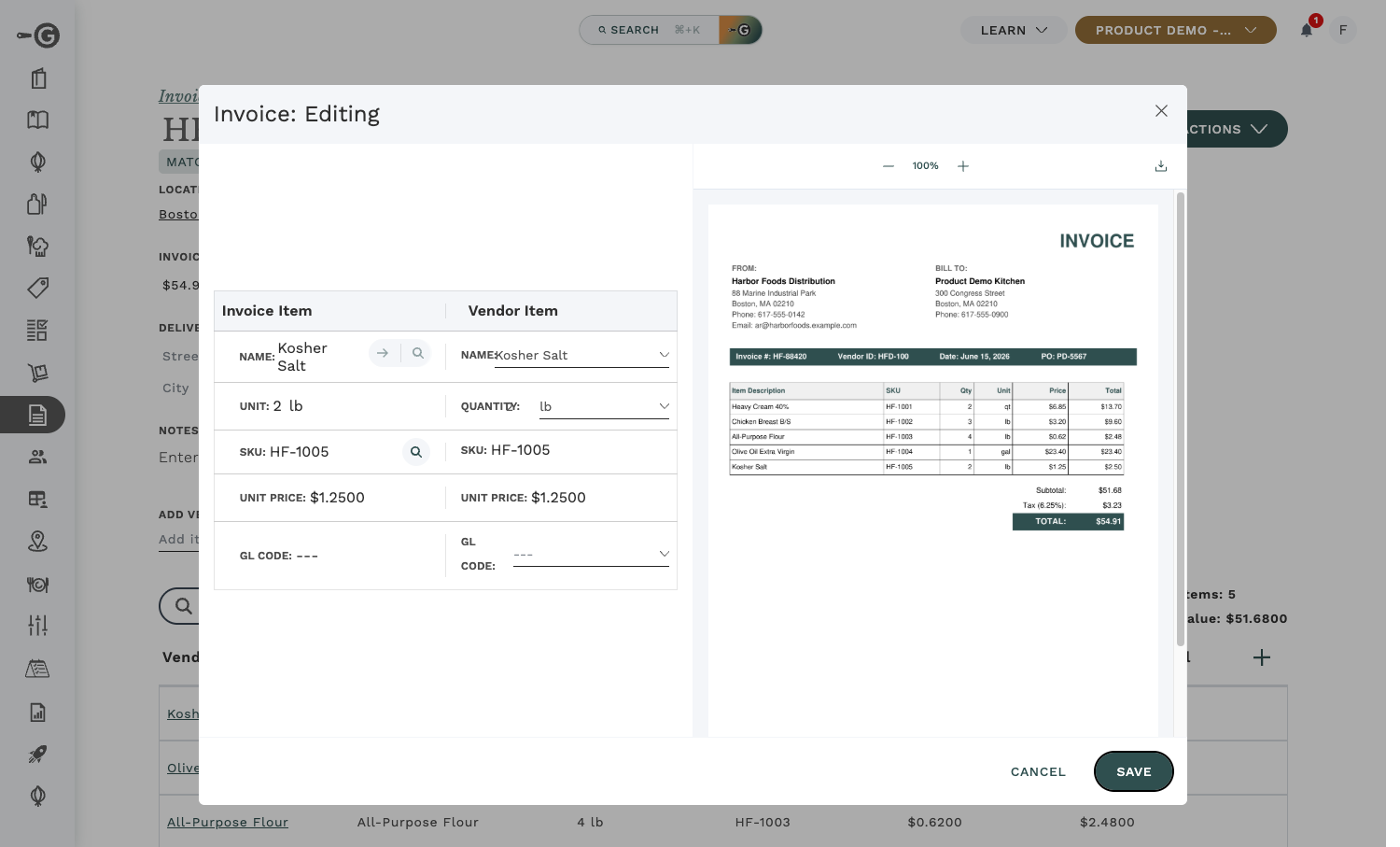
When you open an invoice, you see two panels side by side: extracted data on the left, the original invoice image on the right. Resize the panels to suit your screen. Use the image panel to zoom, pan, and navigate between pages, comparing the extracted data against the source at a glance.
Editable Invoice Fields
You can edit the following fields directly in the review view. Changes save automatically. All edits must happen before the invoice is approved. Once approved, these fields are locked.
| Field | Notes |
|---|---|
| Invoice date | Correct if the AI picked up the wrong date |
| Tax amount | Adjust if the extracted tax is incorrect |
| Total cost | Correct the invoice total if needed |
| Shipping address | Update if the delivery address differs |
| Notes | Add internal notes for your team |
| Vendor | Triggers automatic re-matching to the new vendor's catalog |
| Location | Moves the invoice to the correct location |
AI-extracted fields such as the invoice number, PO reference, and external invoice ID can be edited before approval on invoices that Galley scanned. Once an invoice is approved, all fields are locked. If you do not see the edit option, the invoice may already be approved, or it may have been entered manually rather than scanned.
Correcting Line Items
Open any line item to edit the matched vendor item, quantity, unit, cost, or GL code. You can also:
- Add line items the AI missed
- Ignore items that should not be processed (such as informational or promotional lines)
- Assign or change GL codes using autocomplete
Seeing Who Submitted an Invoice
For invoices that arrived by email, you will see the sender's email address, and their name if they are a Galley user, on the invoice and as an optional column in your invoice list. Useful for following up when something looks off.
Deleting Invoices
If an invoice was uploaded by mistake or is a test upload, you can delete it permanently. Delete from the invoice page, the invoice list, or the upload history page. Bulk deletion is also available.
Deletion is permanent and cannot be undone. You can only delete invoices that have not yet been approved. Approved invoices cannot be deleted. Deletion requires the "Delete Invoice" permission. Contact your company administrator if you need access.
Item Mapping
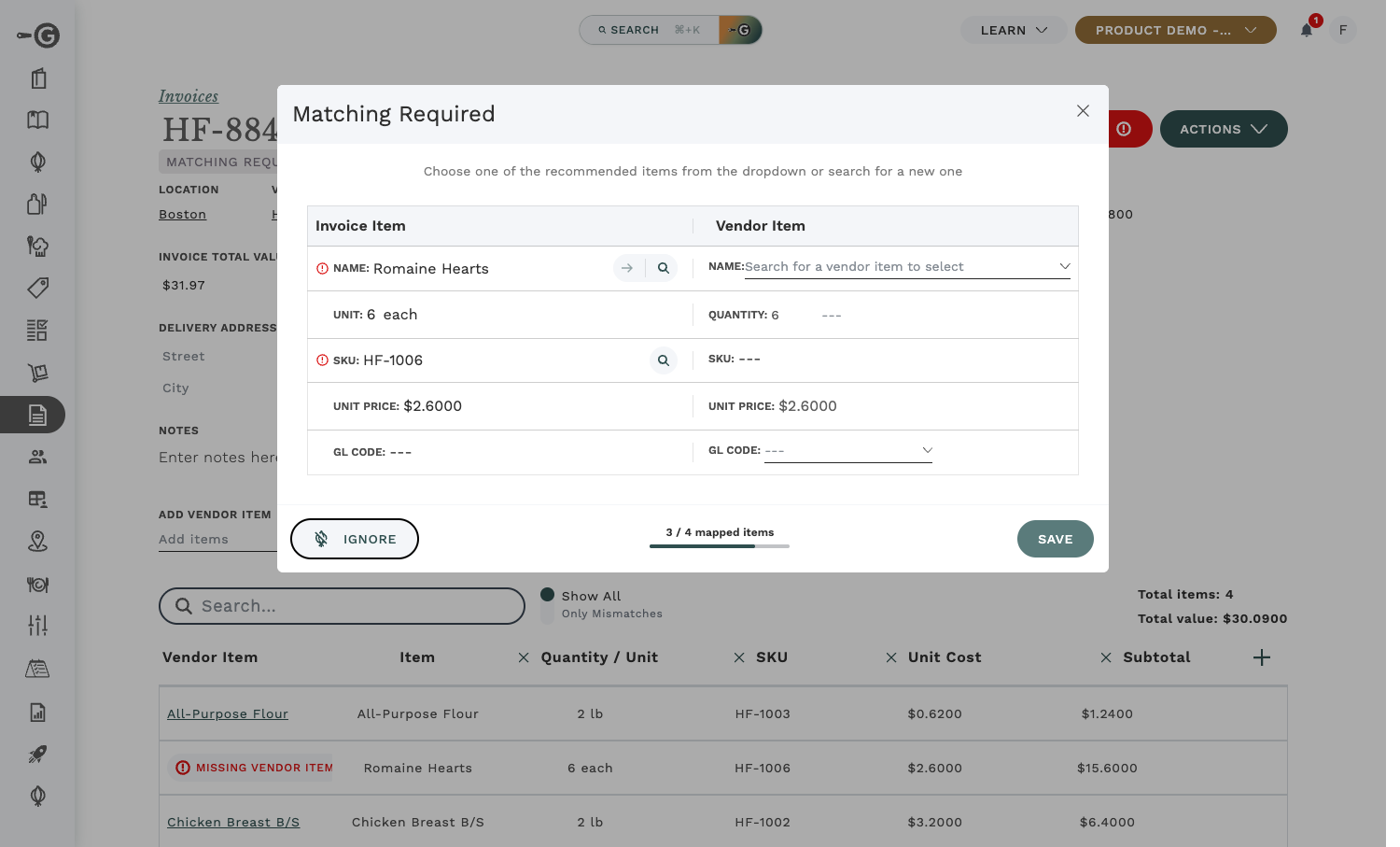
Before an invoice can be approved, every line item must be matched to a vendor item in your catalog. Galley handles most of this automatically. Items it cannot match with confidence are queued for your review.
How to Map Items
Open an invoice with pending items and work through the queue:
- Select the unmapped item.
- Search your vendor catalog for the correct match.
- Confirm the vendor item and unit.
- Move to the next item.
If the item does not exist in your catalog yet, you can create it directly from the mapping flow, no need to leave the invoice.
Auto-Creating Vendors and Items
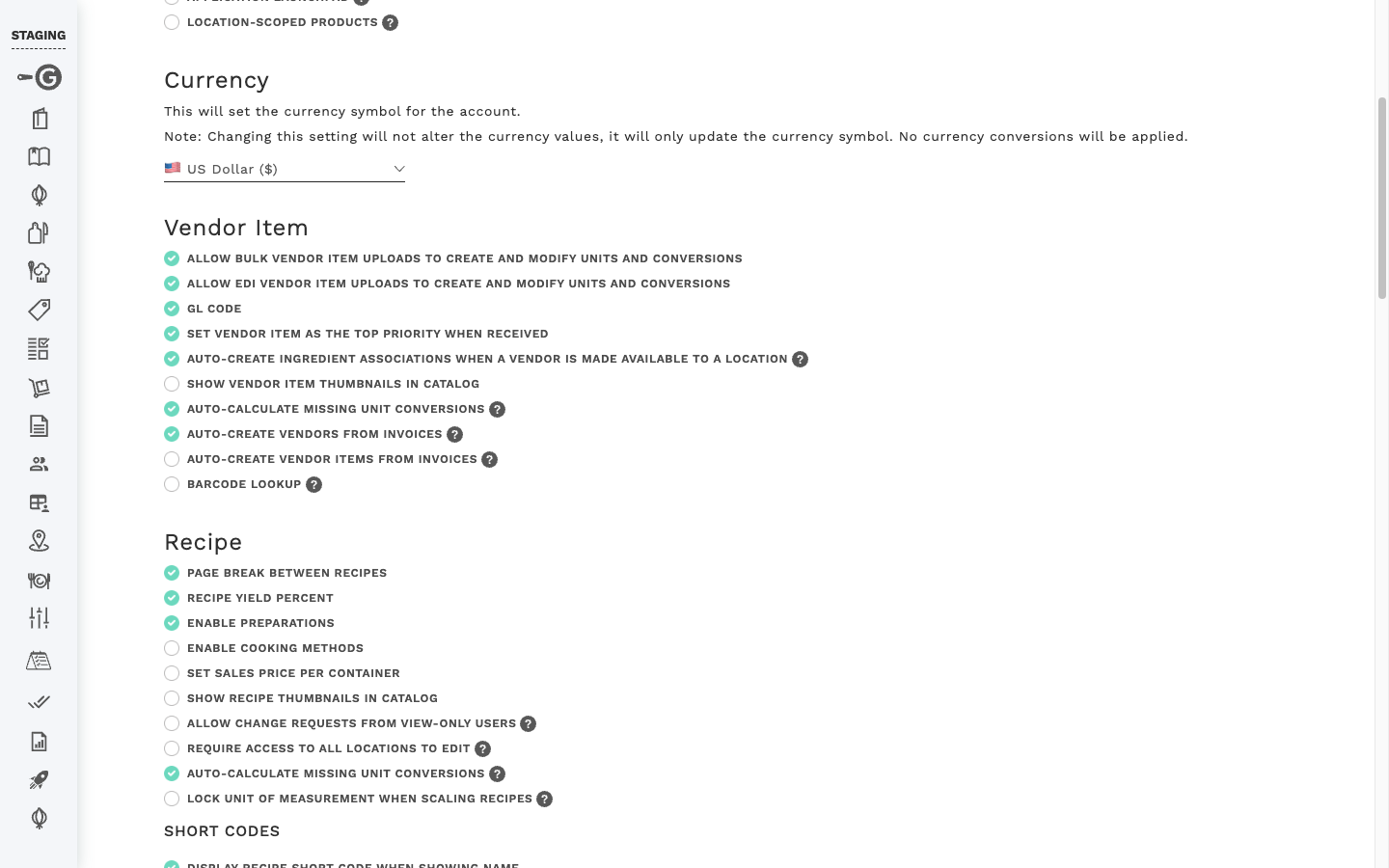
Galley can build out your catalog for you as invoices come in. Two optional settings, found under Settings, Company Settings, turn this on:
- Auto-create vendors from invoices: when an invoice arrives for a vendor that does not exist yet, Galley creates the vendor automatically from the name and address printed on the invoice. Auto-created vendors are tagged so you can tell them apart from ones you entered by hand.
- Auto-create vendor items from invoices: when an invoice line references a vendor item that does not exist yet, Galley creates the vendor item automatically. This applies to standard units like lb, oz, each, and gallon. Items in non-standard units like case or bag still go to manual review so you stay in control.
Both settings are off by default. For an auto-created vendor item to also pick up its price, set up an Auto-Update Costs approval rule under Settings, Invoice Rules, Approval Rules. Ask your company administrator to enable these if you want Galley to grow your catalog automatically.
SKU Mismatches
When the SKU on an invoice differs from what is in your catalog, Galley gives you two options:
| Option | What it does |
|---|---|
| Update SKU | Updates your vendor item so future invoices from this vendor match automatically |
| Match only | Matches this invoice once, without changing your catalog |
Fees, Tax, and Other Non-Product Lines
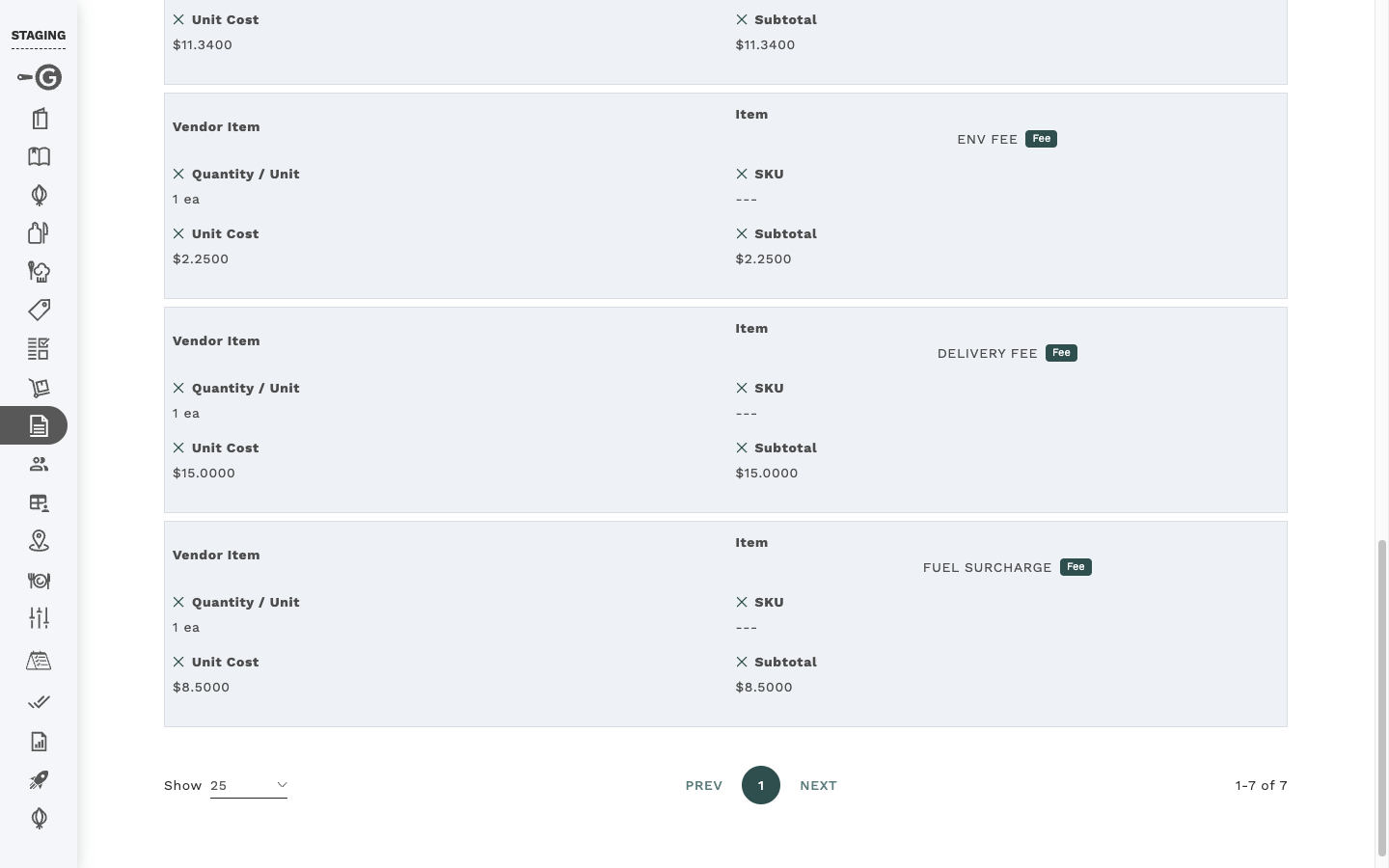
Not every line on an invoice is a product. Fuel surcharges, delivery fees, freight, handling charges, small-order fees, and tax lines are not catalog items. Galley recognizes these automatically and labels them as Fee or Tax.
Non-product lines behave differently from product lines:
- They skip vendor item matching, so they never show an "unmapped" warning and never block approval.
- They are grouped separately in the line item list so products stay easy to scan.
- You can change a line's type by hand if Galley classifies it incorrectly.
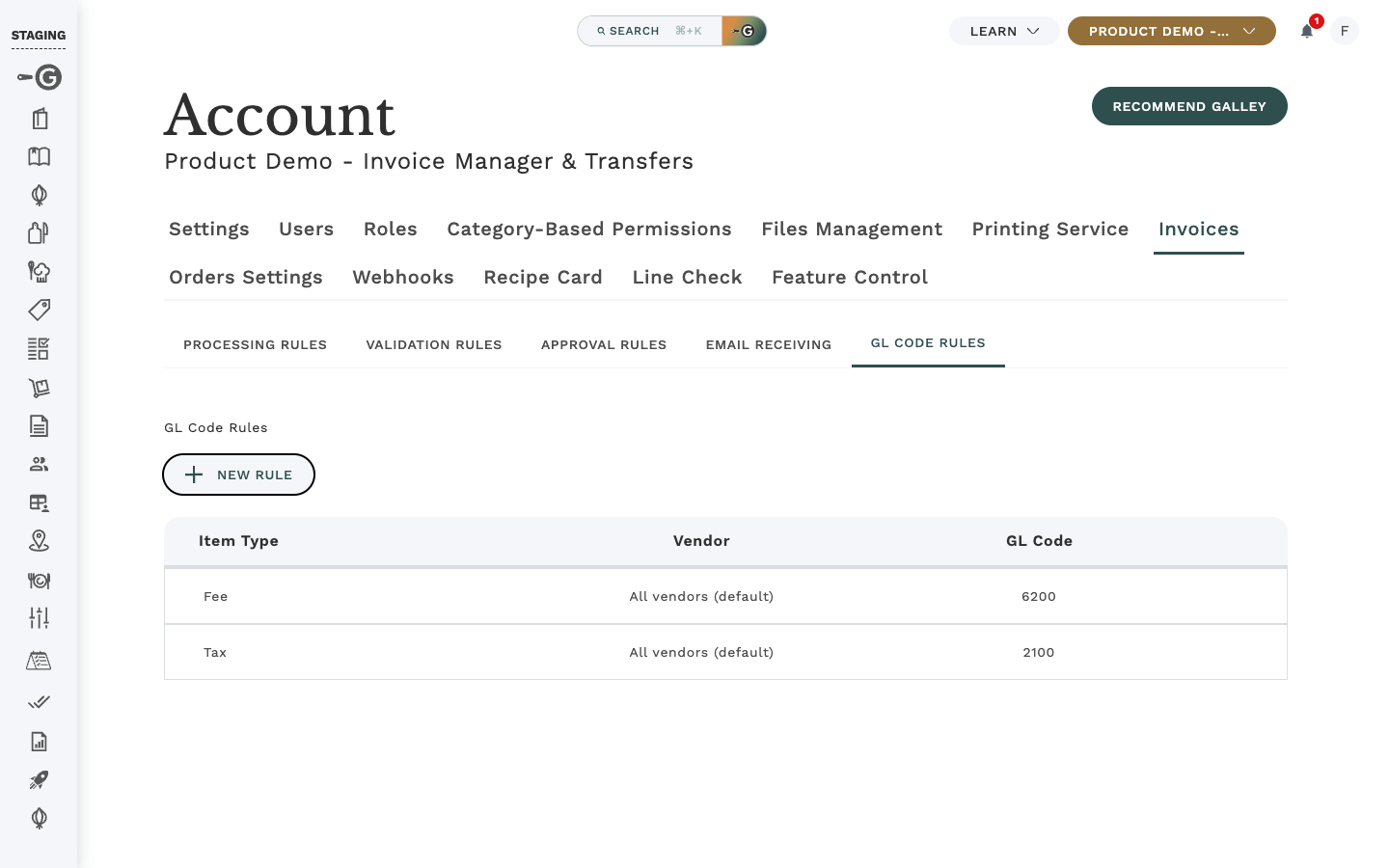
Set up GL Code Rules to code fees and tax automatically. For example, send all fees to one GL code and all tax to another, and Galley applies them on every invoice. You can still override the code on any individual line. Find this under Settings, Invoice Rules, GL Code Rules.
What Blocks Approval
An invoice cannot be approved until every product line item is resolved. Fees and tax do not need matching, so they never block approval. Galley shows a count of pending items at the top of the invoice.
| Blocker | How to fix |
|---|---|
| No vendor item matched | Search and confirm from the mapping flow, or create a new vendor item |
| No unit assigned | Assign the purchasing unit during item mapping |
| GL code required but missing | Add a GL code to the line item (applies if your company has GL validation enabled) |
Approving an Invoice
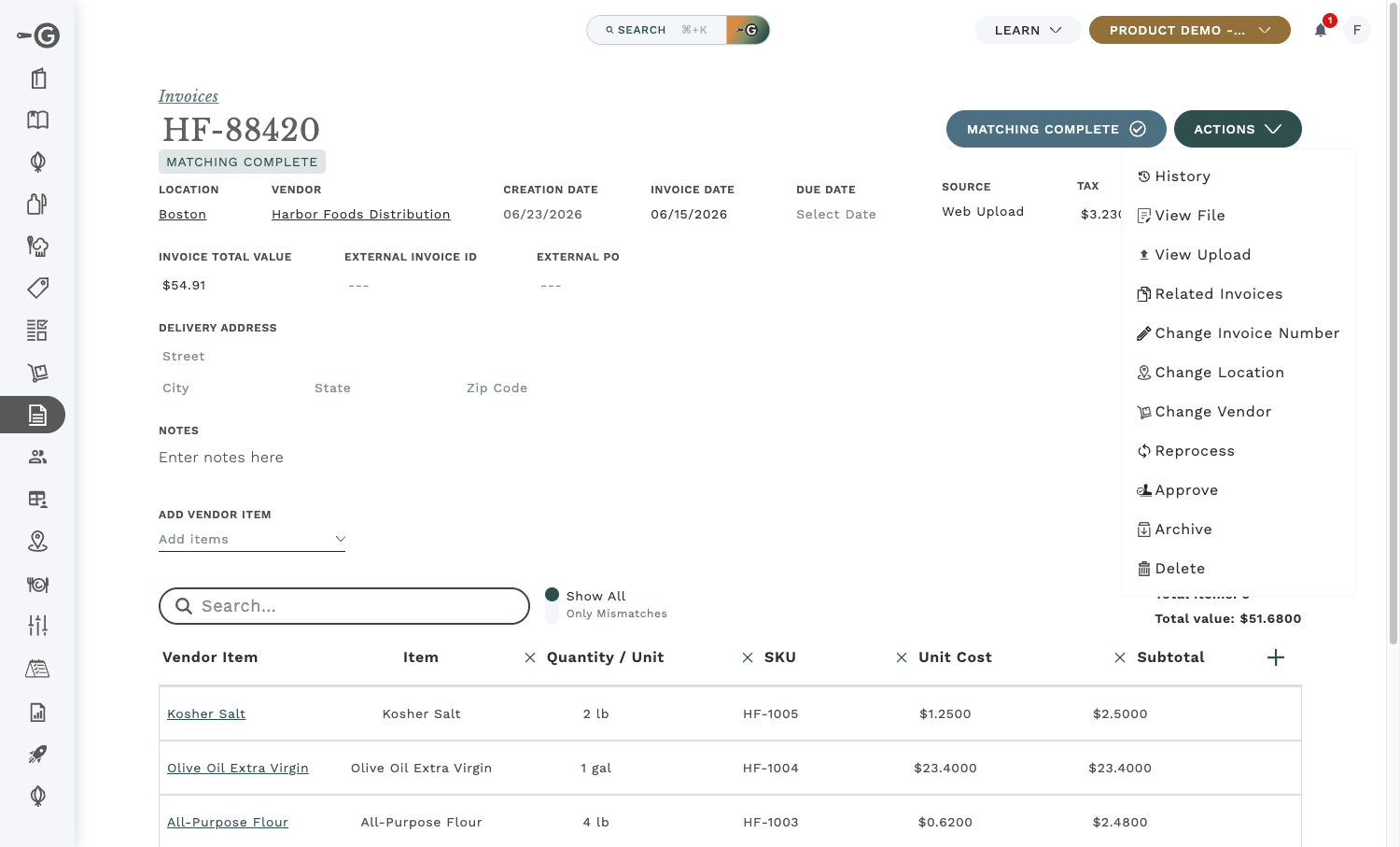
Once all items are mapped and the data looks correct, click Approve. Approval is the final step: it locks the invoice and updates your records.
| What approval does | Details |
|---|---|
| Locks the invoice | The invoice can no longer be edited |
| Updates cost history | Vendor item costs are updated with the prices from this invoice |
| Creates a receiving record | Inventory is updated to reflect the received goods |
Unapproving an Invoice
Approved by mistake? Use "Unapprove" to reverse it. This unlocks the invoice for editing and rolls back the vendor item costs and receiving records it created. Approve again once your corrections are in place.
Auto-Approval Rules
For vendors you trust completely, auto-approval rules let Galley skip the manual review step. When matching is complete, the invoice is approved automatically.
Auto-approval rules can be scoped to specific vendors, specific locations, or applied company-wide. Contact your company administrator to configure them.
GL Code Validation
Your company may require every line item to have a GL code before an invoice can be approved. When this rule is active, Galley blocks approval until all GL codes are filled in, keeping your accounting data clean on every invoice.
The Invoice Catalog
The invoice list shows all invoices across your locations. Filter, sort, and take bulk actions to stay on top of large volumes efficiently.
Filters
| Filter | Options |
|---|---|
| Status | Draft, Matching Started, Reprocessing, Matching Requires Review, Matching Failed, Matching Complete, Approved, Complete, Duplicated, Archived |
| Date range | Invoice date, created date, modified date, or due date, any custom window |
| Vendor | One or more specific vendors |
| Location | One or more locations |
| Invoice number | Search by invoice number, external invoice ID, or PO |
Your active filters are saved between sessions. When you come back to the invoice list, Galley picks up right where you left off.
Bulk Actions
Select multiple invoices using the checkboxes and apply an action to all of them at once, approve, archive, or delete. Especially useful after large batch uploads when many invoices are ready at the same time.
Customizing Your View
Show or hide columns to focus on what matters most to you. The "Submitted by" column is available if you want to see who forwarded each invoice via email.
Upload History
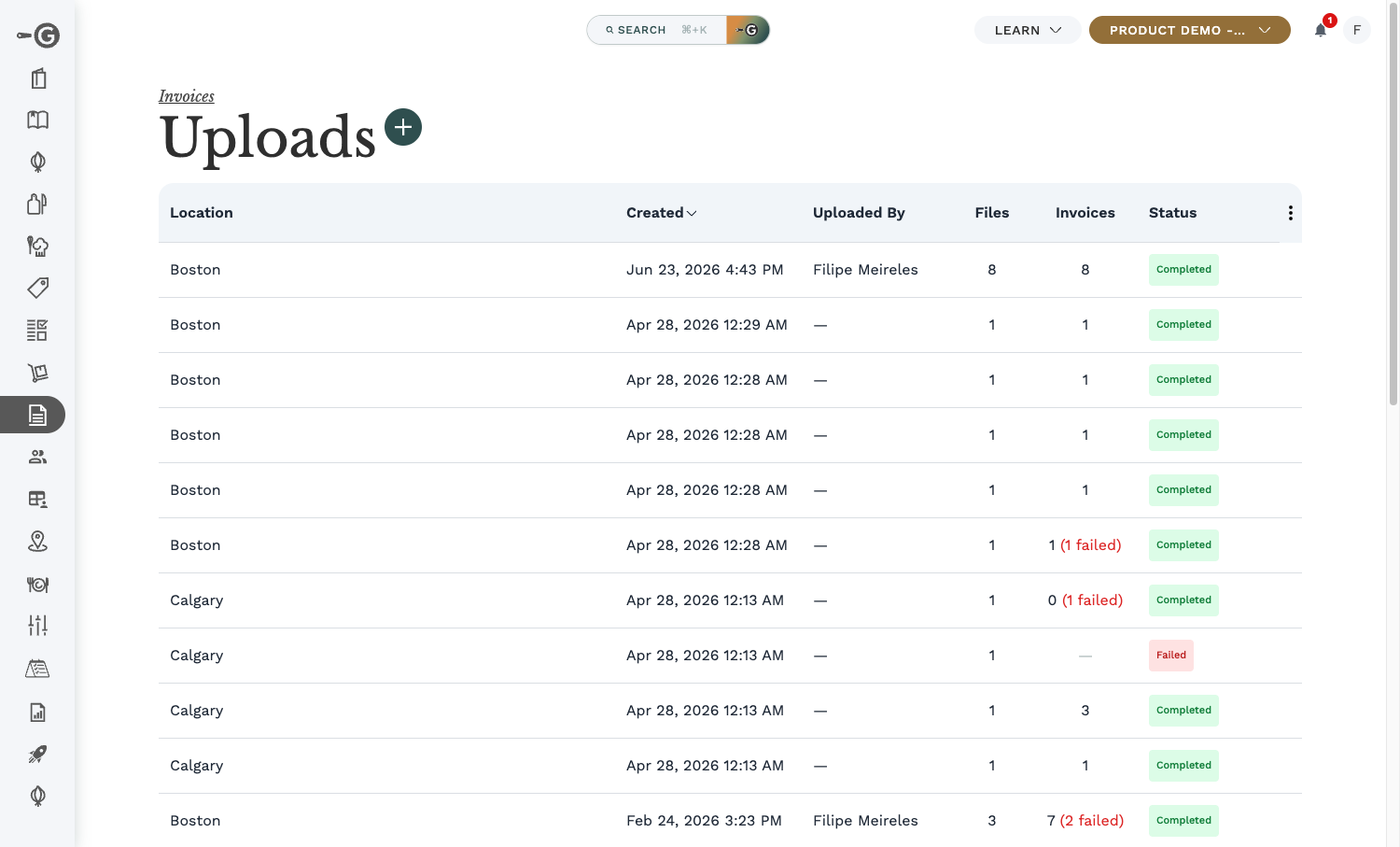
The Upload Jobs page keeps a record of every batch upload: how many files came in, how many invoices were detected and created, and any that failed or need attention. Reprocess or delete individual invoices directly from this view.
Use the Upload Jobs page as your audit trail. It shows exactly what came in, when, who submitted it, and how each document was processed.
Common Issues and Quick Fixes
| Issue | What to check |
|---|---|
| Invoice stuck in "Matching Started" or "Reprocessing" | Wait a few minutes and refresh. If it stays stuck, select it in the invoice list and reprocess it. |
| Invoice came back as "Matching Failed" or "Matching Requires Review" | Open it to resolve flagged items, or select it in the list and reprocess to re-run matching. |
| AI matched the wrong vendor | Use "Change Vendor" to correct it. Items re-match automatically. |
| All line items are unmapped | The vendor's catalog is likely empty. Add vendor items from the mapping flow. |
| Cannot approve the invoice | Check for pending items: missing vendor item, unit, or GL code. |
| Invoice number looks wrong | Use "Change Invoice Number" to correct it (available before approval). |
| Email forwarded but no invoice showing | Check that the sender's domain is on the allowed list under Settings, Invoice Rules, Email Receiving. |
| Invoice shows wrong location | Use "Change Location" to move it before approving. |
| Accidentally approved an invoice | Use "Unapprove" to reverse it. Costs and receiving records are rolled back. |
| Cannot edit an invoice field | The invoice may already be approved. Unapprove it first, then edit. Manually entered invoices do not have editable AI-extracted fields. |
Frequently Asked Questions
Can I upload multiple invoices at once?
Yes. Drag multiple files onto the upload area to process them in a single batch. You can also send multiple attachments in one forwarded email. Galley processes them all together.
What happens if the same invoice is uploaded twice?
Galley detects duplicates based on vendor, location, and invoice number. Duplicate invoices are grouped and flagged. You choose which one to keep as the active invoice.
Can I edit an invoice after it has been approved?
No. Approving locks the invoice. If you need to make changes, unapprove it first. Costs and receiving records will be rolled back. Make your corrections, then approve again.
What if a vendor sends an invoice to the wrong location's email?
The invoice arrives under the wrong location. Use "Change Location" to move it to the correct location before approving.
Can I set up auto-approval for some vendors but not others?
Yes. Auto-approval rules can be scoped to specific vendors, specific locations, or applied company-wide. Contact your company administrator to configure them.
Why can't I edit the invoice number?
AI-extracted fields like the invoice number can only be edited before approval, and only on invoices that Galley scanned. If the invoice was entered manually, or has already been approved, these fields are not editable. Unapprove the invoice first if you need to change it.
What file types does Galley accept?
Galley accepts PDFs and common image formats. Multi-page documents are supported, and a single file can contain multiple invoices. Galley splits them automatically.
Can I delete an invoice?
You can permanently delete invoices that have not been approved. This requires the "Delete Invoice" permission. Approved invoices cannot be deleted, but they can be archived.
What happens to fees and tax on an invoice?
Galley recognizes non-product lines such as fuel surcharges, delivery fees, freight, handling charges, and tax, and labels them as Fee or Tax. These lines skip vendor item matching, so they never show an "unmapped" warning and never block approval. If you set up GL Code Rules, fees and tax are coded automatically. You can change a line's type or its GL code by hand at any time before approval.
Does Galley get better at reading my invoices over time?
Yes. When you correct something the AI read on a scanned invoice, Galley learns from that correction and applies it to future invoices from the same vendor, so extraction gets more accurate the more you use it. The same applies to item mapping: a vendor item you map by hand is remembered and matched automatically next time.
Can Galley create vendors and vendor items automatically?
Yes, if your administrator turns it on. Two optional settings under Settings, Company Settings let Galley create a vendor from an invoice when that vendor does not exist yet (using the name and address on the invoice), and create vendor items for invoice lines in standard units like lb, oz, each, and gallon. Both are off by default, and items in non-standard units like case or bag still go to manual review.