
Jump to: Overview · Before you start · Cooking method · Build the recipe · Water · Weigh a batch · Reading the totals · Methods vs preparations · Yields to test · Troubleshooting · FAQ
Why grains need their own setup
Most of the ingredients you cook get smaller. Meat renders and loses fat, greens wilt down, vegetables give up water. Grains do the opposite: a pound of dry rice comes out of the steamer weighing well over two pounds.
Your nutrition analysis is calculated against dry grain, which concentrates every nutrient far above what your guest actually eats.
Setting up a grain recipe correctly means four things are in place:
- The raw grain ingredient has a cooking method with a yield above 100%, because the grain gains weight/ expands during cooking.
- That cooking method points at the cooked version of the ingredient, so nutrition reflects the cooked grain rather than the dry.
- The water in the recipe is accounted for honestly, since some of it stays in the grain and some evaporates.
- The recipe has a yield conversion based on a batch your team actually weighed.
Once it is built, you have a sub recipe you can drop into bowls, entrees, and sides, and the weight, cost, and nutrition follow it everywhere.
Build one grain sub recipe per grain and per cooking style, then reuse it such as a single well-tested 'Cooked White Rice' recipe.
Before you start
Gather these first. You can build the recipe without the last one, but it is what turns a good estimate into a number you can stand behind.
- The raw grain ingredient in Galley, with a nutrition source attached.
- The cooked version of that grain in the USDA database, so the cooking method has something to point at.
- A cooked yield percentage for your kitchen. Start from the reference table further down if you do not have your own number yet.
- The cooking method your team actually uses. Steamed and boiled behave differently, especially where draining is involved.
- A weighed batch. Have the kitchen weigh the finished product the next time they run it.
If your team measures finished grain by volume rather than weight, that is fine and common. You will still want one weight from one batch, because weight is what lets Galley connect your volume yield to nutrition. You only need to capture it once per grain, not every service.
Step 1: Set up the cooking method on the raw grain
This step happens on the ingredient, not the recipe, and it only needs doing once per grain. Every recipe that later calls for cooked rice benefits from it.
- Go to Ingredients and open your raw grain ingredient, for example Rice, White.
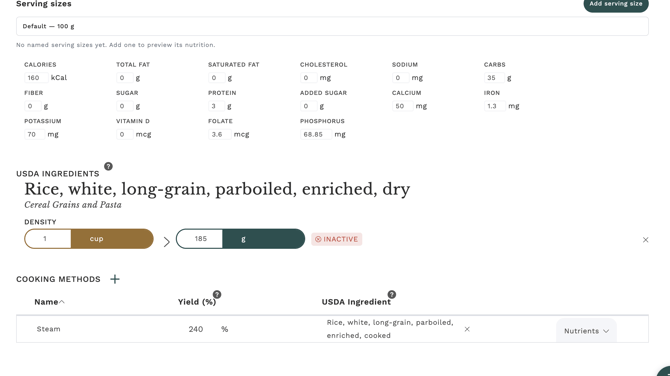
- Navigate to the Nutrition tab and scroll down tot the Cooking Methods section. Add a cooking method and name it for what your kitchen does, such as 'Steamed'.
- Enter the cooking yield. For grains this is above 100%, because the grain absorbs water and gains weight. White rice commonly lands around 240%.
- In the cooking yield section, attach the cooked version of the ingredient from the USDA database, for example cooked white rice.
- Repeat for each grain you use: brown rice, quinoa, farro, barley, and so on.
Adding the Cooking Method to the grain ingredient in a recipe is the part many people skip, and it is the part that makes nutrition correct. Without it, Galley scales the weight up but keeps reporting the nutrient profile of dry grain, which concentrates everything per gram far higher than what your guest is actually eating.
This is the same pattern you already use for proteins, where you set a browned and drained method that loses weight. The mechanics are identical. The only difference with grains is that the percentage goes up instead of down.
Step 2: Build and name the sub recipe
- Create a new recipe and name it for the cooked product: Cooked White Rice, Cooked Quinoa, Cooked Brown Rice.
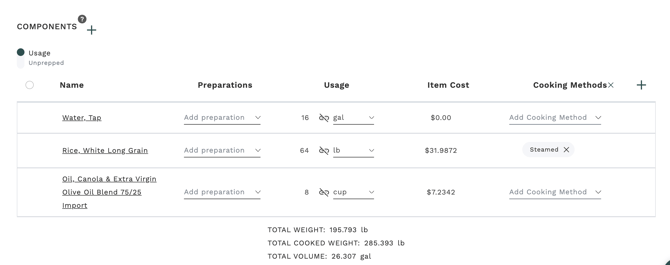
- Add your raw grain ingredient and the quantity your standard batch uses.
- Add water and the quantity your team uses for that batch.
- On the grain ingredient line, apply the cooking method you set up in Step 1.
Put Cooked in the recipe name. When someone is building a bowl and searching for rice, the name is the only signal telling them whether they are pulling dry weight or cooked weight into their recipe. A recipe called White Rice is genuinely ambiguous, and that ambiguity is where scaling errors come from.
Applying the cooking method on the ingredient line is what activates everything you set up in Step 1. You can watch it work: remove the cooking method and the cooked weight at the bottom of the recipe drops back toward the raw weight, then add it back and the cooked weight rises.
Step 3: Decide how much of the water counts
Water is the one line on a grain recipe that needs a decision from you. Some of the water you add ends up inside the grain and stays there. Some of it leaves as steam. And with pasta or boiled grains, most of it goes down the drain.
You tell Galley which of those is happening using the nutrition contribution percentage on the water line, in the nutrition components table.
The contribution percentage does more than adjust nutrients. Lowering it also removes that share of the physical product from the recipe, so it changes your weights as well as your nutrition. This is why the setting deserves a deliberate choice rather than a default.
How to think about the percentage
The clearest way to understand this setting is a marinade. You marinate chicken for 24 hours, then drain off the excess and discard it. Only the marinade that soaked into the chicken should count toward the finished product, so you might set the marinade to contribute 10%. The other 90% never reaches the plate, so its weight and its nutrients both come out.
Water in a grain recipe works the same way. Set the percentage to match how much of that water actually stays in the finished product.

Whatever you choose here, your kitchen instructions do not change. Your team still puts the same rice and the same water in the steamer every time. The percentage is how Galley reconciles that with the weight that comes out.
Step 4: Weigh a real batch and set the conversion
This is the step that makes the whole recipe trustworthy. Everything up to now is a well-informed calculation. This replaces it with a measurement.
- Have the kitchen run the recipe as written.
- Weigh the finished product. If you normally yield in gallons or pans, capture the weight of that full batch alongside the volume.
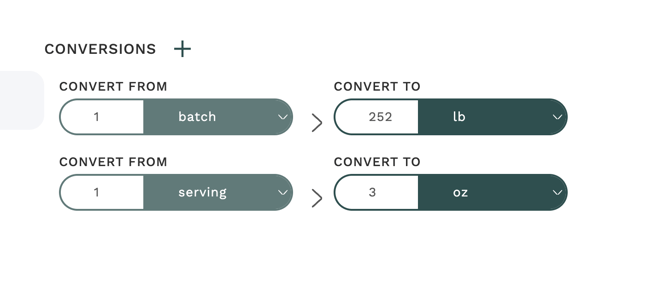
- Set the recipe yield in the unit your team uses, for example, 42 gallons.
- At the top of the recipe, add a custom unit and conversion that ties your yield unit to that weight, for example 42 gallons equals 145 pounds.
- Compare the weight you measured to the cooked weight Galley shows at the bottom of the recipe. If they differ meaningfully, revisit the cooking yield in Step 1 and the water percentage in Step 3.
A conversion you set yourself always takes precedence over anything Galley calculates. That is the point of this step.
That conversion is also what drives your nutrition fact panel. When you menu the recipe and define a serving as three ounces, the conversion is what tells Galley that three ounces means three ounces of finished cooked grain.
You do not need a perfect number on the first pass. Set your best estimate, tell the kitchen the recipe changed and that the yield may come out differently, and ask them to report what they get. Two or three runs will get you somewhere solid, and grains are consistent enough that the number holds once you have it.
How to read the totals at the bottom of a recipe
The totals at the bottom of a recipe are useful, but each one answers a different question, and none of them accounts for evaporation. Knowing what each is telling you saves a lot of second-guessing.
| Total | What it is | What it is not |
|---|---|---|
| Total weight | Your raw inputs, after any preparation yields are applied | Not your finished weight |
| Total cooked weight | Calculated from the cooking methods you applied to each ingredient line | Not a measurement, and it does not subtract evaporative loss |
| Total volume | The prepped volume, calculated from the density conversion on each ingredient | Not the cooked volume, and it is only as good as those density conversions |
Treat these as information rather than as your yield. Your yield is what you set at the top of the recipe from a weighed batch. The totals at the bottom are how Galley shows its work.
Total volume is genuinely useful on the line, even though it is a raw number. Chefs use it to work out how many tilt skillets or hotel pans a batch will need. Just make sure your team knows not to compare it against the finished yield, and that it is telling them about volume going in rather than product coming out.
Cooking methods and preparations are not interchangeable
Both adjust weight, so it is reasonable to reach for either one. They act at different points in the process, though, and using the wrong one on a grain causes a purchasing problem rather than a yield problem.
| Preparation | Cooking method | |
|---|---|---|
| When it applies | Before cooking: trimming, peeling, chopping, draining | During cooking |
| What it drives | How much raw product you need to buy | Cooked weight and cooked nutrition |
| Effect on purchasing | Yes, Galley buys more raw product to cover the loss | No |
| Effect on top level recipe yield | No | No, you set that yourself |
| Right choice for a grain | No | Yes |
Do not use a preparation to represent cooking. On an ingredient that gains weight, a preparation yield will tell Galley to purchase the wrong quantity of raw grain, and your yield still will not be right. Use a cooking method.
Starting yields to test against
Published grain yields vary, and so do kitchens. Steam versus boil, batch size, pan depth, and how long a batch holds all move the number. Use these as a starting point, then replace them with your own.
| Grain | Starting point | Notes |
|---|---|---|
| White rice | Around 240% | A reliable figure in practice, and consistent with what comparable operations use |
| Brown rice, quinoa, and other absorbed whole grains | Roughly 200% to 300% | These absorb differently from white rice and from each other. Worth testing individually |
| Pasta and grains you boil and drain | Test yours | These gain weight too, but the water you discard is handled on the water line rather than in the cooking yield |
How to find your own number
- Have the kitchen cook one grain on its own, without the rest of the recipe around it.
- Weigh it dry, then weigh it cooked.
- Divide the cooked weight by the dry weight and multiply by 100. That is your cooking yield percentage.
- Run it twice if you can. Two consistent results tell you far more than one.
Cooking an ingredient separately to weigh it is worth doing once per grain, and it is not something your team needs to repeat. Once the percentage is in Galley, it does the work on every recipe that uses that grain.
Troubleshooting
| What you see | What it means | What to do |
|---|---|---|
| The kitchen under yields against the recipe | The cooking yield is too low, or the water percentage is too high | Weigh a batch, then adjust the cooking yield in Step 1 and the water percentage in Step 3 until Galley agrees with the scale |
| Cooked weight barely differs from raw weight | The cooking method is set up on the ingredient but was never applied to the ingredient line in the recipe | Open the recipe and apply the cooking method to the grain line. Remove it and add it back to confirm the cooked weight responds |
| Nutrition looks too concentrated per serving | The cooking method has a yield but no cooked ingredient attached, so nutrition is still coming from dry grain | Open the ingredient and attach the cooked version in the cooking yield section |
| No total volume shows at the bottom of the recipe | An ingredient is missing a volume or density conversion, so Galley cannot add the volumes together | Click Find Errors next to the Actions button. If that does not identify it, change the unit on each ingredient in turn and look for the one with no compatible volume unit |
| Per serving nutrition looks wrong even though the recipe is right | The recipe has a yield but no conversion tying it to a weight | Add the custom unit conversion described in Step 4 |
| Your yield changed after you edited the recipe | A conversion you set earlier is overriding your new inputs | Update the conversion at the top of the recipe. Your own conversions always take precedence |
| A suggested density conversion appears with a confidence rating | Galley is offering an estimated density rather than a measured one | Check it against your own measurement before relying on it, particularly if nutrition accuracy matters for your labels |
Frequently asked questions
Should a cooked grain be a sub recipe or an ingredient?
A sub recipe. Cooking grain involves a second component, the water, and a decision about how much of it stays in the product. An ingredient cannot hold that. Building it as a sub recipe also means you set it up once and reuse it everywhere, so a yield correction updates every recipe that calls for it.
Why is my cooking yield above 100%?
Because grains absorb water and get heavier. That is expected and correct. A yield below 100% on a grain is the thing to question.
Do I need a separate sub recipe for each cooking method?
Only if the results are genuinely different. Steamed rice and boiled and drained rice end up at different weights and hold different amounts of water, so they deserve separate setups. Two names for the same process do not.
Can I skip weighing a batch?
You can, and a well-set-up recipe using the reference yields will get you much closer than no setup at all. But a weighed batch is what turns an estimate into a number you can defend on a label and scale on with confidence. It is one weighing per grain.
What if my yields are inconsistent from batch to batch?
Grains are usually stable, so real inconsistency points at something else: batch sizes changing, a switch between steaming and boiling, or holding time varying. Cook the grain on its own and weigh it a couple of times to establish the grain's own yield, then look at the process around it for the remaining variance.
Should I set water to zero because it has almost no nutrients?
No. The percentage controls physical weight as well as nutrients, so zeroing water out removes weight your finished product actually has. Set it to reflect how much water stays in the grain, which for rice is most of it.
How do 'each' units work on a cooked grain recipe?
Define what an 'each' weighs. If you tell Galley the recipe makes 40 each without saying what a serving is, it simply divides the batch by 40 and calls that an each. Once you define one eah as four ounces of finished grain, portioning and nutrition both line up with what your team is actually scooping.
Does any of this change what my kitchen does?
No. Your team puts the same grain and the same water in the steamer as before. What changes is that the quantities Galley gives them when the recipe scales are the ones that produce the yield you expected.